
Our Story
Built on
Strategy.
The Group
APW Avenue Group
Founded in 2001 by James R. Parks in Los Angeles, APW Avenue Group is a privately held real estate investment and development firm built around a single discipline: strategically identifying properties where APW can provide value, then restructuring them into long-term equity. The firm's portfolio spans luxury hospitality - anchored by Hotel Barrière Fouquet's New York in Tribeca — alongside multifamily and mixed-use assets in high-growth and premier U.S. markets.
The firm partners with institutional capital to acquire, reposition, and develop high-potential real estate assets. With a proven track record of successful value-add and opportunistic investments, the firm delivers strong risk-adjusted returns while creating premium housing and hospitality experiences.
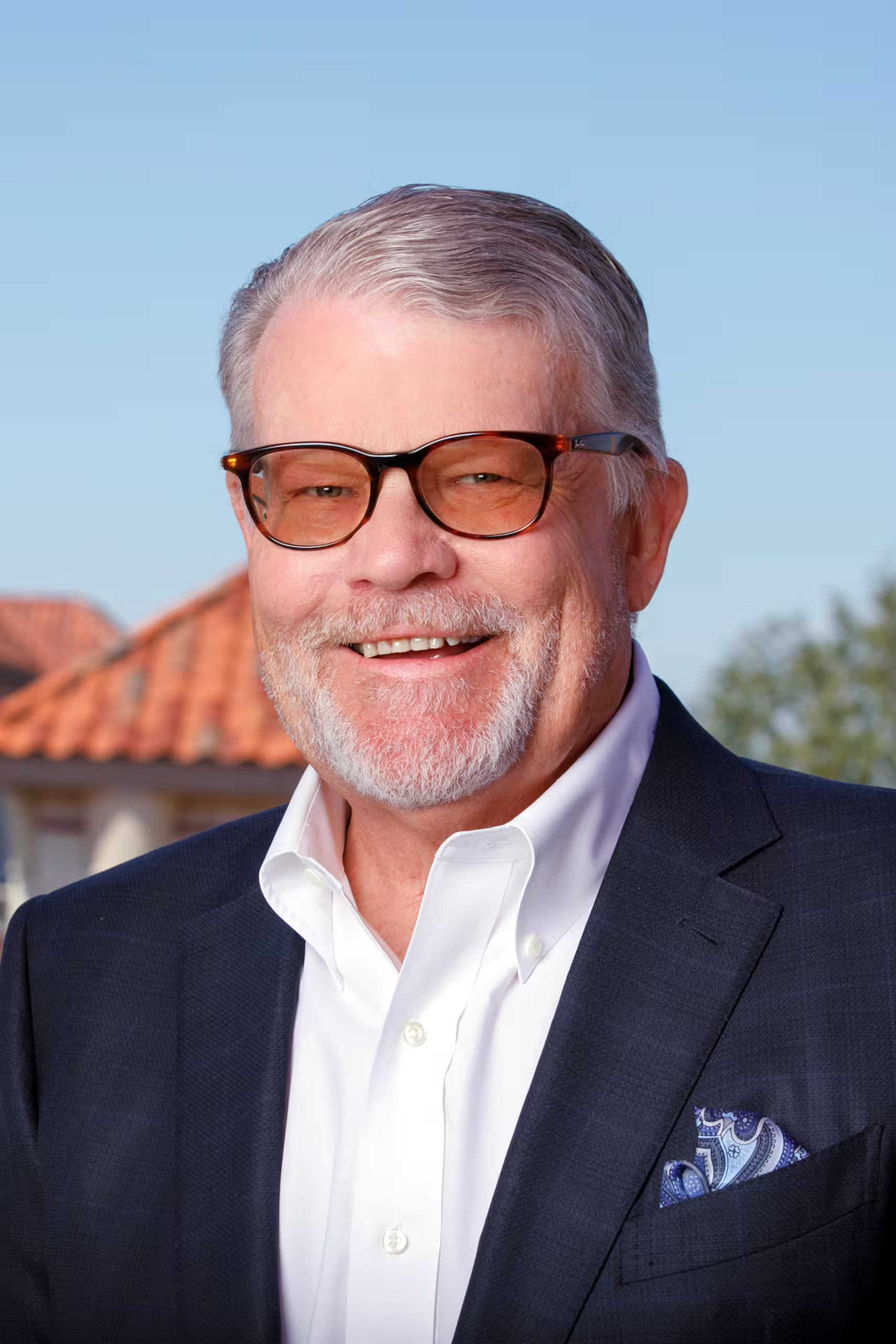
James R. Parks
Founder & Owner

Leadership
James R. Parks
James R. Parks, a CPA and the founder of APW Avenue Group, began his career as a Los Angeles tax accountant serving figures across the entertainment industry. It was the first step in a career that would extend into television post-production, multifamily real estate, and corporate turnarounds.
Across those industries, his role has been consistent. Parks gravitates toward complicated, often distressed situations involving companies and assets and figures out how to make them work again. He then moves on to the next challenge.
That approach has defined a career spanning more than four decades. It is also the thread that ties together what might otherwise look like a scattered résumé: accounting, media, multifamily housing and hospitality.
From humble beginnings to tax expertise
Parks was born in Glendale, California and raised in the San Fernando Valley. His upbringing was modest. His father worked as a machinist at Lockheed, while his mother taught elementary school.
He initially planned to study engineering but lacked the financial resources to attend a four-year university. Instead, he enrolled in junior college, where he developed an interest in anthropology. At the same time, he took an accounting course, recognizing anthropology’s limited earning potential.
Accounting quickly stood out. It was almost effortless for Parks, and a professor recognized his aptitude and helped him secure a job at an accounting firm. Faced with a choice between pursuing anthropology and accounting, Parks chose the latter.
He later transferred to the University of Southern California, working nearly full-time while completing his degree. After graduating in 1972, he continued working while pursuing graduate studies at night. Initially enrolled in an MBA program, he shifted into USC’s newly established Master of Business Taxation program, becoming part of its first cohort.
Entering entertainment and building a client base
During that period, he was recruited by Peat Marwick, now KPMG, which offered him a position in its tax department in 1973. A pivotal moment came soon after when he was assigned to the Century City office, which specialized in entertainment and oil and gas. The exposure to these two industries reshaped his career trajectory.
One assignment involved Western Airlines, owned by businessman and investor Kirk Kerkorian. Through that work, Parks met Kerkorian’s attorney, Greg Bautzer who later became a client and an important early relationship.
Parks’ eventual departure from Peat Marwick was driven by the type of clients he wanted to serve. While the firm was focused on corporate accounts, Parks had become a go-to tax accountant for major clients in the entertainment industry. When he left to start his own firm, many of those clients followed.
A key factor in launching his firm was the Vidal Sassoon company, a client of his that agreed to pay fees in advance. That upfront revenue gave Parks the capital needed to get the firm off the ground.
In 1984, James partnered with others to form Parks, Palmer, Turner & Yemenidijan. The firm grew into one of Los Angeles’ leading accounting and business management companies in entertainment. And it did more than handle taxes. It served as the financial backbone for artists, producers and studios navigating wealth, unpredictable income and intricate deals. Parks also developed a specialty in forensic accounting, serving as an expert in partnership matters for the U.S. Department of Justice and as an accounting expert in court proceedings involving motion picture accounting disputes.
Over time, his client list grew to include prominent figures across the entertainment industry, though many of those relationships remain private. He has also worked as a tax and business consultant for major studios including MGM and Twentieth Century Fox, as well as many independent film companies.
But the real value, especially for clients working in volatile industries, is judgment: knowing when something is fixable and when it is not.
Navigating a shifting media landscape
His first major test of that instinct came in an unlikely place: television and motion picture post-production. Parks saw an opportunity to acquire Pacific Video out of bankruptcy and became involved with a related company, Spectra Image, which owned Laser Edit. These entities ultimately merged to form LaserPacific Media Corp., which would play a role in the industry’s transition from analog film processes to digital entertainment production. In the late 1980s, Parks was with the team that took the company public.
He served on the board and later became chairman and chief executive in 1993, at a time when the company was struggling financially. He was simultaneously overseeing his accounting firm and a real estate operation he had co-founded with his partners, balancing three businesses at once.
Under his leadership, LaserPacific stabilized and adapted. The company earned six Engineering Emmy Awards for its technical contributions, including work tied to the development of high-definition television. Parks even installed one of the earliest high-def TVs in his home, despite the lack of available broadcasts at the time.
By the early 2000s, LaserPacific had grown valuable enough to sell. Eastman Kodak acquired the business in 2003, when Kodak was an industry leader, folding it into a broader push into digital media services.
For Parks, it was a familiar arc: stabilize, restructure and exit.
In 1998, Century Business Services — now CBIZ — acquired Parks, Palmer, Turner & Yemenidjian. Parks remained with CBIZ, where he continues to serve as an executive director, building a Western-region practice serving high-net-worth individuals and complex businesses. The work spans tax strategy, litigation support and financial restructuring.
Real estate and ‘the deal of the century’
Parks’ real estate activities are another major component of his career. The roots of his portfolio trace back to the early 1980s, when he and one of his partners, Mike Palmer, began moving from smaller investments into larger multifamily deals in Los Angeles. One of their first major acquisitions — two apartment buildings totaling roughly 360 units — marked a shift in scale.
The breakthrough came soon after. Working with a client, they combined those units with a much larger portfolio and sold the package to institutional investors, roughly doubling their investment in about 18 months. The client viewed it as the “deal of the century.” This portfolio was eventually curated to include roughly 7,000 apartment units.
In 1984, Parks and Palmer established Realty Center Management Inc. to manage their holdings and those of their clients. Parks remains chairman of the center’s board and a 50% shareholder.
Following his first big transaction, Parks focused on distressed or transitional assets, often tied to broader financial disruption. In one case, he acquired a portfolio ahead of a savings and loan failure and later restructured the debt through the Resolution Trust Corp. (RTC), creating roughly $70 million in value. The RTC was a temporary U.S. government-owned asset management company created in 1989 to liquidate assets from insolvent savings and loan associations during the 1980s crisis.
In another transaction, Parks gained control of an office building through a reworked capital structure for about $12 million and sold it years later for $58 million.
A similar approach defined a later portfolio acquired through a middleman tied to the RTC. Purchased for roughly $25 million, the assets were repositioned over time and today represent a holding valued at more than $200 million — one that Parks still owns.
Their biggest deal in the 1980s occurred when they bought an office building at 509 Madison Ave. in New York City, which later sold in the 90’s.
APW Avenue Group Stabilizing Fouquet’s New York
In 2001, as a solo venture, he founded APW Avenue Group, a privately held real estate investment and development firm focused on acquiring and restructuring assets that require more than passive ownership, including multifamily housing, hospitality and mixed-use properties in high-growth and premier markets in the United States.
Few examples illustrate that better than Fouquet’s New York, which Parks took over as majority owner. The Tribeca hotel project that would become Fouquet’s New York was, for a time, defined more by its problems than its promise.
The property was plagued by development delays, financial strain and bankruptcy proceedings. By the time Parks became involved around 2019, it was a situation many investors would have avoided.
That’s usually when he steps in.
Over the next several years, the project was restructured and stabilized. The hotel ultimately opened in 2022, bringing the Paris-based Barrière brand to New York. But the real inflection point came later.
In early 2026, a $145 million refinancing led by Goldman Sachs replaced earlier financing and placed the project on firmer long-term footing. For Parks, it marked the end of a cycle that had begun in distress, years of work distilled into a single transaction.
Beyond Manhattan, Parks’ recent real estate highlights include completing a $96 million multifamily housing purchase, capitalizing on the major industrial growth in Reno, Nevada; acquiring an apartment complex with a marina in Marina del Rey for $62 million; and buying a 26-story apartment tower in downtown Los Angeles for $69 million.
He also purchased an historic 34,000-square-foot Castle, in upstate New York. Originally built in 1927 for a well-known historical figure and family. Parks intends to refurbish the private home to its historic state, preserving its original beauty, and to use the property as a location for photo and video shoots.
Corporate and board leadership
Parks has held roles on several for-profit boards throughout his career. He currently serves on the boards of Whittier Trust, a wealth management and investment firm, and CalPrivate Bank.
Earlier in his career, he served on the board of Sybron Dental Specialties, a New York Stock Exchange-listed company that was later sold to Danaher in a transaction valued at more than $2 billion in 2006.
Philanthropy and institutional leadership
Not all of Parks’ work is transactional. He has built a parallel reputation in philanthropy and institutional leadership, particularly tied to the University of Southern California. He serves on the USC Marshall School of Business’ Board of Councilors and Board of Advisors for the Master of Business Taxation program.
In 2015, he made a $15 million gift to USC’s Leventhal School of Accounting to endow a chair, support facility renovations and name the Master of Business Taxation program in honor of his late wife, Jennifer. The investment was aimed at shaping the next generation of tax professionals, not simply reflecting past success.
“The education and preparation I received over my years at USC Leventhal was the foundation for much of my future success,” Parks told USC at the time. “My late wife, Jennifer, and I felt strongly that it was our duty to give back one day.”
His nonprofit involvement extends well beyond academia. Parks has held leadership roles with the Autry Museum of the American West, where he previously served as chairman of the board of trustees, and remains involved with the California Art Club, one of the nation's oldest nonprofit organizations dedicated to promoting and supporting traditional fine art. He has also been involved with the California Council of Economic Education, which will honor him in 2026 for his longtime support of education. Parks had previously served as a board member at the nonprofit for many years.
Parks’ interest in art is longstanding. His mother introduced him to museums and cultural institutions at a young age, shaping what would become a serious pursuit. He has spent years collecting and studying works tied to the American West, drawn to both their history and craftsmanship. He is likely among the top 10 collectors of American Western art in the U.S., owning pieces by Frederic Remington, Charles M. Russell and Georgia O'Keeffe.
Parks even intended to pursue graduate-level studies in the field at Williams College in Williamstown, Massachusetts, but the Covid-19 pandemic disrupted those plans. Still, the move underscored how seriously he approaches the subject. His continued connection to the Clark Art Institute as a trustee in Williamstown shows a similar focus on stewardship.
Recognition has followed. Parks has been named to the Los Angeles Business Journal’s LA500 list of the city’s most influential leaders for nine consecutive years and was honored as a Beta Alpha Psi Outstanding Alumnus by USC Leventhal. The publication has also recognized Parks twice as one of the top accountants.
In addition, Parks was named an Entertainment Industry Business Visionary by LA Times Studios in 2024, part of the program’s inaugural class recognizing leaders across the Southern California entertainment industry. He received the recognition again in 2025.
Life beyond the balance sheet
For all the complexity of his professional life, Parks’ personal interests are grounded in something simpler. He is an avid equestrian, known to spend time riding his horse, Roy. He is also an auto enthusiast with an appreciation for engineering and design, and he maintains homes across the country. He’s an enthusiastic golfer as well, having played 92 of the top 100 golf courses in the world.
And then there’s the part of his life that operates far from the West Coast.
A different kind of investment
Parks and Chrystina “Xtina” Parks, whom he married in 2018, have become increasingly involved in wildlife conservation efforts in Africa.
Xtina’s path into that work was unconventional. A former PR and marketing professional, she found her way to Africa more than a decade ago focusing on her love of photography, documenting wildlife and supporting conservation initiatives. Today, she leads projects that combine storytelling, art, ecological preservation and economic support for local communities through an ecosystem of efforts.
Her work, alongside her talented teams, extends through ventures like the nonprofit ROAM Africa Conservation, ROAM A Xtina Parks Gallery in Williamstown, and an artist residency which connects African artists and artisans with global audiences while supporting conservation efforts on the ground.
The Parks also spend time in Botswana, where conservation, land stewardship and sustainable tourism intersect. For Parks, this is a different kind of turnaround work—focused on preserving environments under pressure—and yet his life’s theme is evident throughout.
At Botswana’s Limpopo-Lipadi, a wildlife and wilderness reserve, Xtina Parks serves on the Conservation Committee, where efforts focus on habitat restoration, species reintroduction and the protection of endangered wildlife, including the southern white rhino and African wild dog.
The Parks’ involvement is driven by a broader view of conservation, one that connects wildlife protection, cultural preservation and support for local communities so both people and ecosystems can thrive.
Their joint investment is also seen at the Chrystina and James R. Parks Research Center at the Autry Museum in Burbank, California, reflecting a commitment to preservation.
Next generation leaders
In recent years, Parks has increasingly focused on what comes next and who will lead it. He spends time mentoring emerging leaders, coaching them, building relationships and helping position them to carry forward the work. That group includes Amy Chen, Dillon Kruger, Betty Liu, Shannon Pearce and Ken Tindall.
Their role reflects a shift from individual problem-solving to institutional continuity: building teams capable of navigating the same kind of layered challenges that defined Parks’ career.
Across industries and decades, Parks has operated in the background, bringing structure to situations that lacked it and patience to ones that required it. His work is about understanding what is worth saving, what is not and how to move something from instability to strength.
It is a role that does not fit neatly into a single title, but it has defined his career all the same.
Portfolio Highlights
High Growth & Premier Markets
Fouquet's New York
New York, NY
Villa Del Mar
Marina del Rey, CA
717 Olympic
Downtown Los Angeles, CA
Parks Castle
Millbrook, New York
The Harbors
Sausalito, CA
Motlhala Tau Lodge
Botswana, Africa